Numerical Simulations & Machine Learning
Numerical simulations provide the backbone for modelling how cosmic structure grows and how galaxies evolve within it. My work uses large cosmological dark-matter simulations, including the Millennium and MillenniumTNG simulation suites, together with the Gadget-4 framework to connect the evolving dark-matter distribution with physically motivated models of galaxy formation.
My approach
I combine large-scale N-body simulations with semi-analytic models of galaxy formation. The dark-matter simulations follow the growth of haloes and large-scale structure, while L-Galaxies models the baryonic processes associated with galaxy formation and evolution along the resulting merger trees.
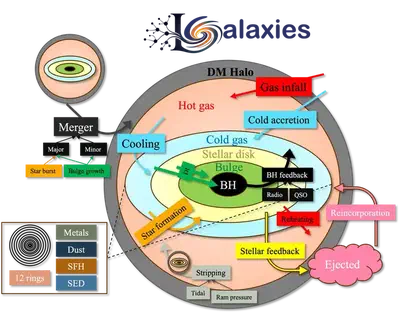
My work focuses on developing, implementing, and testing self-consistent physical prescriptions within the Gadget-4 + L-Galaxies framework. These include star formation and stellar feedback, mergers, disc instabilities, black-hole growth, and galaxy quenching.
Scientific and high-performance computing are central to this work. I use Python and C/C++ to develop and analyse simulation workflows, process multi-dimensional and multi-terabyte datasets, and explore galaxy populations across large parameter spaces.
The same modelling philosophy also extends to stellar-population work through CALOMERA, a semi-analytic chemo-dynamical Milky Way model for population synthesis and Galactic evolution studies. More details are available on the Local Stellar Populations & the Milky Way page.
Statistical inference and machine learning
A major part of the modelling process is identifying which combinations of physical parameters are consistent with observations. I use statistical inference, MCMC-based calibration, and machine-learning approaches to constrain model parameters and explore parameter space efficiently.
Deep-learning surrogate models can emulate computationally expensive model outputs, accelerating calibration and enabling a much broader exploration of physical parameter space than would be feasible with direct model evaluations alone.
Connecting models and observations
The resulting predictions are tested against observational constraints including galaxy abundances, star-formation rates, quenched fractions, luminosity functions, galaxy sizes, and structural properties.
This combination of physical modelling, large-scale N-body simulations, scientific computing, statistical inference, and machine learning provides a framework for identifying where current models succeed, where they fail, and which physical ingredients require further development.