Galaxy Evolution & Quenching
Galaxies evolve through the interplay of gas accretion, star formation, mergers, structural transformation, and feedback. Together, these processes determine how galaxies build their stellar mass, regulate their gas supply, and transition from actively star-forming to quiescent systems.
What I investigate
My research follows galaxy evolution from the nearby Universe to the first billion years of cosmic history, with a particular focus on how massive galaxies assemble, develop compact structures, and eventually quench their star formation.
Vani et al. 2025 tested three generations of L-Galaxies against observations from z=0 to z≈10, examining galaxy abundances, star-formation rates, sizes, and stellar-mass surface densities. The models reproduce many global trends, but struggle to produce enough massive, compact quenched galaxies at high redshift.
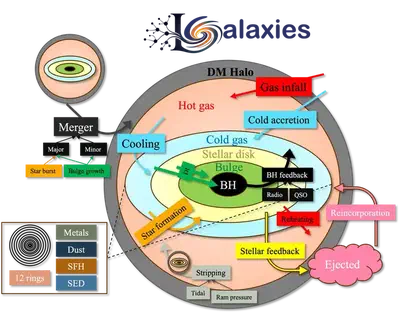
Vani et al. 2026 builds on these results by developing and testing an updated L-Galaxies framework within Gadget-4, with revised physical prescriptions aimed at improving the modelling of early galaxy growth and quenching. The model introduces surface-density-dependent star formation and stellar feedback, dissipative galaxy mergers, and gas- and stellar-based disc instabilities, extending the framework to remain consistent with key observational constraints out to z≈14. The work also develops new calibration methods to efficiently constrain the expanded model.
My approach
I develop and test physically motivated prescriptions within L-Galaxies, combining large cosmological simulations with observational constraints from HST, JWST, and ALMA, as well as current and upcoming large surveys including Euclid and Roman.
The modelling spans star formation and feedback, bulge growth, mergers and disc instabilities, galaxy sizes, and black-hole growth. Model parameters are constrained using statistical inference and large-scale calibration, allowing the resulting galaxy populations to be tested against stellar mass functions, quenched fractions, luminosity functions, galaxy sizes, surface densities, and other scaling relations.
Interactive galaxy cluster formation visualisation
Loading interactive explorer…